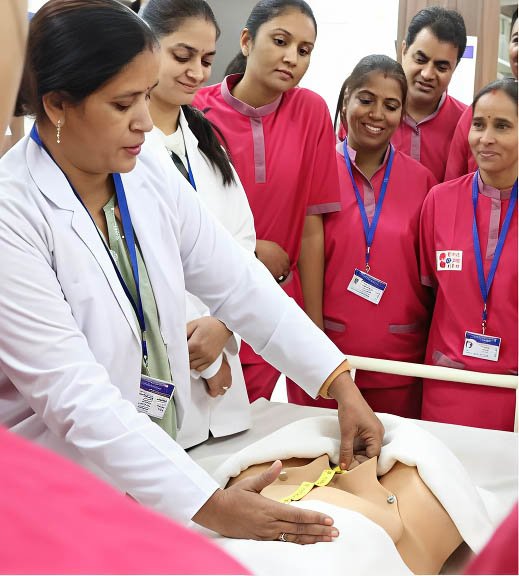
Midwifery Practitioners are specially educated and competency-based trained professionals who provide respectful, evidence-based, woman-centered care during pregnancy, childbirth, postpartum period, newborn care, and reproductive health services in accordance with Ministry of Health & Family Welfare (MoHFW), Government of India, Indian Nursing Council (INC), and International Confederation of Midwives (ICM) standards.
The Government of India launched the Midwifery Initiative to strengthen reproductive, maternal, newborn, and women’s healthcare services through a new cadre of Nurse Practitioner Midwives (NPMs) educated according to competency-based midwifery education standards.
Midwifery practitioners provide skilled, compassionate, respectful, and woman-centered maternity care while promoting normal physiological childbirth, newborn wellbeing, breastfeeding, and family-centered healthcare services.
Midwives work collaboratively with obstetricians, pediatricians, nurses, and healthcare teams while maintaining professional accountability, ethical standards, and evidence-based practice.
Midwifery practice in India aligns with International Confederation of Midwives (ICM) global competency standards and Government of India competency-based midwifery initiatives.
According to the International Confederation of Midwives (ICM), a midwife is a person who has successfully completed a recognized midwifery education programme based on ICM Essential Competencies and Global Standards for Midwifery Education and is legally licensed or registered to practice midwifery in their respective country.
A midwife is an autonomous and accountable professional who works in partnership with women to provide skilled, respectful, evidence-based, and woman-centered care throughout pregnancy, labour, childbirth, postpartum period, newborn care, sexual and reproductive health services.
Midwives support normal physiological processes, promote informed decision-making, advocate for women’s rights, provide health education and counselling, identify complications early, initiate emergency first-line management, and facilitate timely referral when required.
ICM standards recognize midwives as essential healthcare professionals who contribute significantly to reducing maternal and newborn mortality, improving birth experiences, strengthening reproductive health services, and ensuring continuity of care for women and newborns.
Midwives are educated and trained in antenatal, intranatal, postnatal, and newborn care including breastfeeding support, family planning counselling, newborn assessment, health promotion, disease prevention, and respectful maternity care practices.
International midwifery standards emphasize professional ethics, clinical competency, collaboration with multidisciplinary healthcare teams, evidence-based practice, and protection of women’s dignity, privacy, autonomy, and informed choice during maternity care.

In India, a Nurse Practitioner Midwife (NPM) is a specially trained and competency-based midwifery professional who has successfully completed the 18-month Nurse Practitioner in Midwifery programme developed by the Indian Nursing Council (INC) and recognized by the Ministry of Health & Family Welfare (MoHFW), Government of India.
Nurse Practitioner Midwives are independent midwifery practitioners authorized to provide evidence-based, respectful, woman-centered, and skilled maternity care services within their defined scope of practice in accordance with Government of India midwifery guidelines.
NPMs independently provide antenatal, intranatal, and postnatal care, conduct normal physiological childbirth, provide newborn care, identify complications, initiate emergency first-line management, and facilitate timely referral when required.
As defined under the Government of India Scope of Practice for Midwives, NPMs are authorized within their professional scope to order and interpret selected laboratory investigations, prescribe approved medications, provide family planning counselling and services, and deliver comprehensive maternal and newborn healthcare services.
NPMs primarily function in Midwifery Led Care Units (MLCUs) and high caseload healthcare facilities while working collaboratively with obstetricians, pediatricians, and multidisciplinary healthcare teams to ensure safe and quality maternity care.
The Scope of Practice for Midwives in India is defined by the Ministry of Health & Family Welfare (MoHFW), Government of India and Indian Nursing Council (INC) competency-based midwifery guidelines.
Nurse Practitioner Midwives (NPMs) are skilled professionals trained to provide comprehensive maternity and newborn care while functioning primarily in Midwifery Led Care Units (MLCUs) alongside Comprehensive Emergency Obstetric and Neonatal Care (CEmONC) centres.
Nurse Practitioner Midwife Educators (NPMe) are experienced midwifery educators responsible for mentoring, supervising, training, and strengthening competency-based midwifery education.
Midwifery Led Care Units (MLCUs) are specialized maternity care units where Nurse Practitioner Midwives provide respectful, evidence-based, and woman-centered maternity services.
MLCUs promote normal physiological childbirth, early identification of complications, timely referrals, breastfeeding support, and continuity of maternal and newborn care.
These units function alongside Comprehensive Emergency Obstetric and Neonatal Care (CEmONC) centres to ensure safe and quality maternity services.
Search for registered and verified Midwifery Practitioners, Nurse Practitioner Midwives (NPMs), and Midwifery Educators associated with Midwifery Practitioners Association, India.
Search Midwifery PractitionersJoin Midwifery Practitioners Association, India (MPAI) and support safe, respectful, evidence-based, and woman-centered maternity care across India.
Join MPAI